A renewable energy claim is a sentence with evidence behind it. Write the evidence down first. Then write only the sentence it supports.
Most weak claims are not dishonest. They are written from a summary of a summary, months after someone in facilities signed a contract. This note is a method for closing that gap. It is not legal advice, and any public claim should go to counsel before it runs.
Start with what you hold
Before drafting anything, collect four things for the reporting year:
- Electricity use. Total MWh by site, from the bills, for the year the claim covers.
- Certificates retired. Retirement reports showing quantity, vintage, resource type and your company as beneficiary.
- Programs enrolled. Green tariff or community solar statements, and whether the certificates came to you.
- On-site generation. Output from any arrays, and whether you kept their certificates.
EPA says RECs are issued when one megawatt-hour (MWh) of electricity is generated and delivered to the electricity grid from a renewable energy resource (EPA, Renewable Energy Certificates). Retired certificates are the evidence most electricity claims rest on. If item 2 is empty, the claim probably is too.
Our note on what a renewable energy certificate actually is covers retirement reports in more detail.
The four parts of a claim
A supported electricity claim answers four questions:
- What. Renewable electricity, matched by retired certificates or generated on site.
- How much. A quantity in MWh, or a share of total use.
- Where. Which sites, region or business unit.
- When. Which year.
Put together, it reads like this: “In 2026, we retired renewable energy certificates equal to 60% of the electricity used at our 22 Colorado stores.”
That sentence is dull. It is also checkable, and it holds up when a customer, an auditor or a reporter asks for the paperwork.
Drafts and supported versions
| As drafted | The problem | A supported version |
|---|---|---|
| “Our stores run on clean energy.” | No quantity, scope or year; implies physical supply | “In 2026, certificates equal to all electricity used at our 18 Denver stores were retired for us.” |
| “Our solar-powered headquarters” | The array’s certificates were sold | “Our headquarters hosts a rooftop solar array.” |
| “Powered by 100% renewable energy” | Certificates covered 94% of use, rounded up | “Certificates matched 94% of our 2026 electricity use.” |
| “We use renewable energy” | Certificate vintage doesn’t fit the claim year under the reporting standard | Retire certificates with a fitting vintage, or change the year |
None of the supported versions is exciting. That is the point.
Words that need extra care
Some words carry more than they appear to:
- “Powered by.” Readers hear the power at the meter. If the claim rests on unbundled certificates, wording that names the certificates is harder to misread.
- “Clean” and “green.” Vague alone. Put the instrument and the quantity next to them.
- “100%.” Only if retired MWh equals or exceeds MWh used, for the full scope and year.
- “Zero emissions.” Usually reaches well beyond electricity. It needs a full emissions inventory and specialist review, not a certificate purchase.
- Company-wide language. “We” and “our company” imply every site and every fuel, including gas.
The last one catches portfolios that cover electricity at owned sites but not at leased ones. It also catches companies that cover electricity everywhere and gas nowhere, then describe the whole business as renewable.
Scope and year mismatches
Two mismatches are worth checking first, because they are easy to make and easy to spot from outside.
Scope. The claim says “our stores” and the certificates covered 18 of 25. Either narrow the sentence to the 18, or retire certificates for the other seven.
Year. The website still shows last year’s claim late into this year, or the certificates have a vintage the reporting standard does not accept for the claim year. Check the vintage rules of the standard you report to, and put a year in every claim.
A third, quieter mismatch is rounding. If the math says 94%, write 94%. A reader who finds 94% in your sustainability report and 100% on your website will trust neither.
One master sentence
Claims spread. The same sentence ends up on the website, in a sustainability report, in RFP answers, on a store window decal and in a sales deck. Each copy drifts a little as someone shortens it for space.
Write one master sentence per year, approved with its evidence, and keep it in one place. Every other use copies it exactly or points to it. When next year’s numbers land, update the master and replace the copies from a list of where they live.
That list matters more than it sounds. A portfolio with 40 store pages, a careers page and a sales deck can easily have a dozen copies of one claim.
Keep the evidence file
For each claim, keep a file someone outside the team could follow without a meeting:
- the master sentence and the date it was approved
- MWh by site for the year, with the bills as the source
- retirement reports with serial numbers and the beneficiary named
- program statements and contracts showing who holds the certificates
- on-site generation data and certificate ownership for each array
- the name of the person who approved the wording
If you can hand this file to an auditor and walk away, the claim is in good shape. If you cannot, the claim is ahead of the evidence.
The MWh figure is the part most often built by hand. Pull it from the same bill data your finance team uses, so the claim and the utility budget agree on how much electricity the company used.
Claims about on-site solar
A rooftop array supports two different sentences, depending on who holds its certificates.
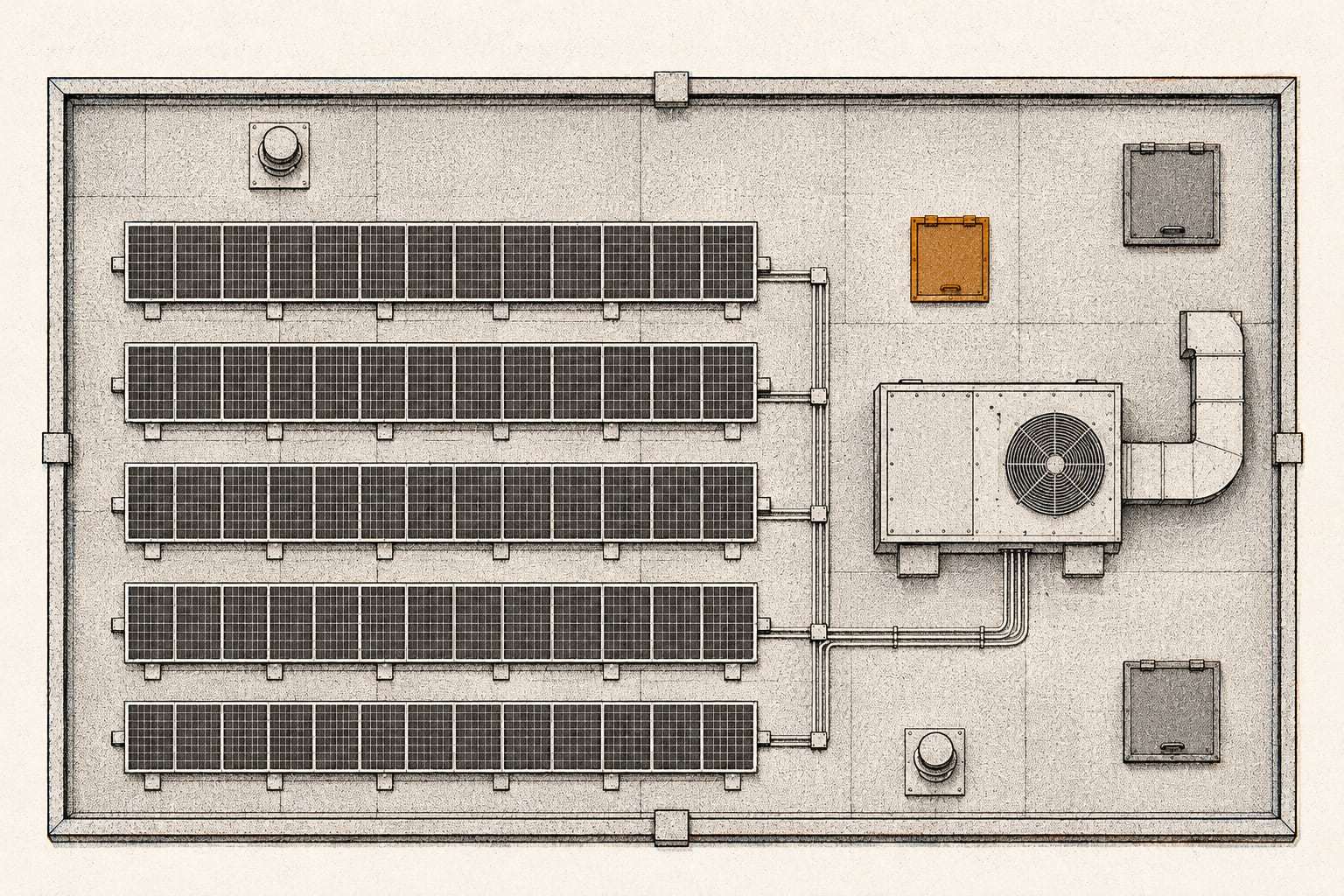
If you kept them, you can describe the power the site used: “In 2026, the array on our Fort Collins warehouse generated 180 MWh, about 30% of the building’s electricity use, and we retained the certificates.” Those figures are illustrative.
If the certificates went to a utility, an installer or a lease counterparty, you can describe the hardware, not the power. “Our Fort Collins warehouse hosts a rooftop solar array” is accurate. “Our warehouse runs on solar” is not, however true it feels to the people who work under the panels.
Claims that mix instruments
Many portfolios cover electricity with more than one instrument: a green tariff at some sites, unbundled certificates at the rest, an array at one. The claim can combine them, as long as the math does not count any MWh twice.
Build it as a small table first: each site, its MWh, and the instrument covering it. Then write the sentence from the total, for example: “In 2026, certificates retired through our utility and in our own name together matched 85% of the electricity used at our 40 sites.” The figures are illustrative; the shape is what matters. It tells a reader what was bought, how much, where and when.
When the portfolio changes
A claim written in March can be wrong by September. A site opens, a store closes, a building is sold. The certificates bought for last year’s scope may not cover this year’s.
Recheck the master sentence whenever the site list changes, not only once a year. If a new site is not covered, narrow the sentence until it is.
Review before it runs
Have counsel review public claims against current federal and state rules on environmental marketing. That review is a legal question, and we do not answer legal questions.
What we check is narrower and more mechanical. Do the numbers in the sentence match the certificates, the bills and the contracts? Does the scope match the sites the certificates covered? Does the year match the vintage?
Our green power buyer’s guide sets out what each green power type lets you claim. It helps most before you buy, when the claim you want can still shape the purchase.
Where to start
A Clean Claims Check reads one reporting year of certificates, program statements and bills against every renewable claim you publish, and shows which sentences the evidence supports. If you have not yet chosen how to buy green power, start with our green utility optimization work, so the claim you want to make shapes what you buy.