In a portfolio of 40 roofs, a handful may be worth an installer’s visit. The rest fail on something dull: a roof due for replacement, a lease with three years left, or a load that peaks after dark.
Screening on paper first spares everyone wasted site visits. Here is the order we use, and what each check looks for. The engineering itself belongs to licensed engineers and installers; this is the work that decides which roofs they should look at.
What solar changes on a bill
On-site solar reduces the kWh a site buys from the utility while the panels produce. That cuts the energy charge. It often does much less to the demand charge.
A 2017 analysis by the National Renewable Energy Laboratory explains that demand charges are typically based on the highest average electricity usage in a defined interval, usually 15 minutes, during a billing period (NREL, via ScienceDaily). If a site’s highest 15 minutes falls at 6 p.m., or on a cloudy afternoon, the panels were producing little when the peak was set.
The same analysis found that demand charges “can account for anywhere from 30% to 70% of a customer’s electricity bill.” For a site near the top of that range, solar mostly works on the smaller part of the bill. Run a site’s numbers through the demand charge calculator to see its demand share before counting any solar savings.
Exports matter too. Power the site cannot use at the moment it is produced flows to the grid, and the tariff decides what it is worth. Read the current net metering or export terms for each utility in the portfolio. Xcel Energy, Colorado Springs Utilities and Fort Collins Utilities each publish their own, and they change.
Screen one: the roof
An array sits on a roof for many years. Before anything else, answer four questions:
- Age. If the roof needs replacing within the array’s life, reroof first. Removing and reinstalling panels later costs money.
- Structure. Can the roof carry the added weight, including ballast on a flat roof? A licensed structural engineer answers this.
- Clear area. Rooftop units, vents, skylights and required setbacks take usable space fast.
- Shading. Taller neighbors, parapets and trees, through every season.
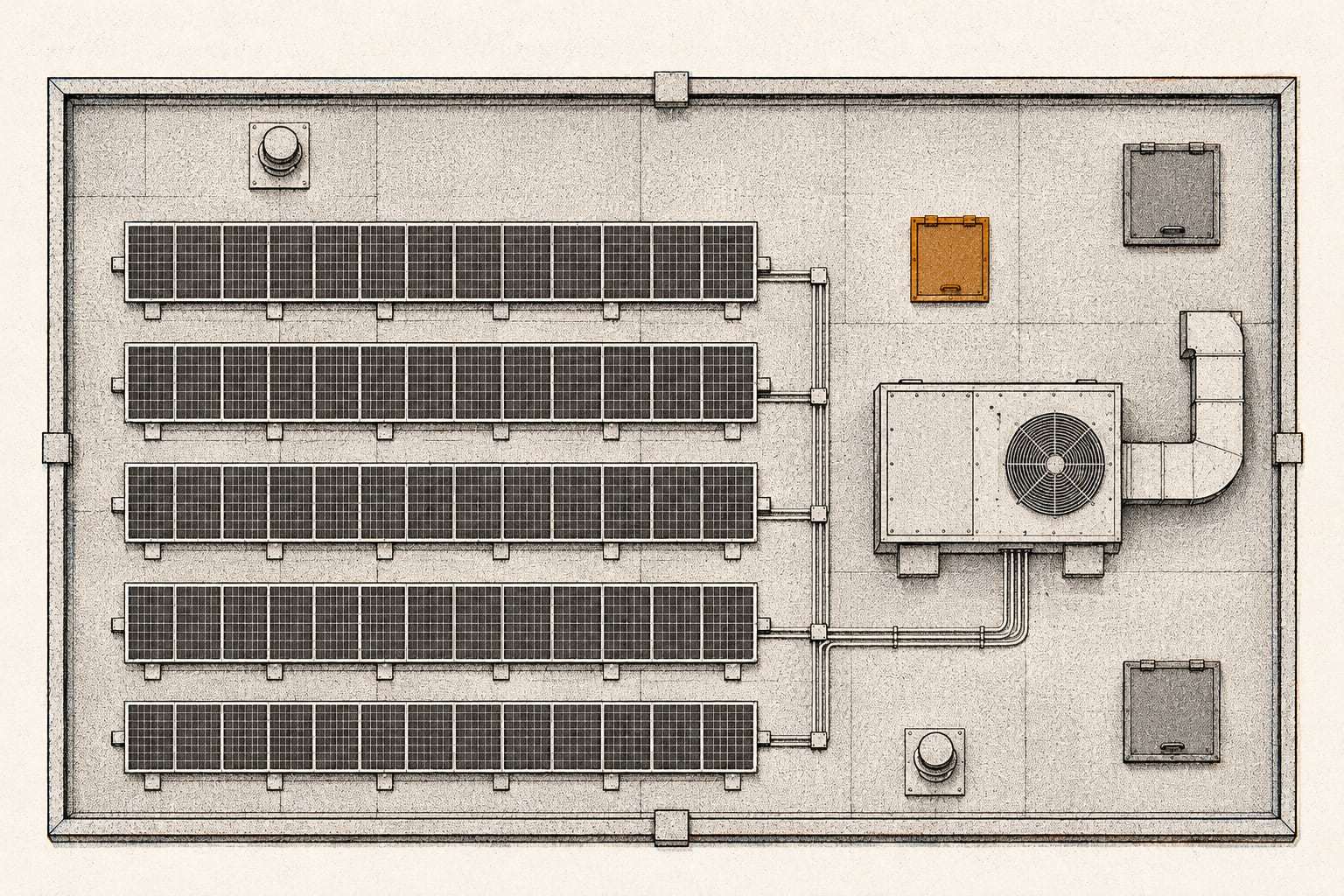
A retail roof that looks large from the parking lot can lose much of its area to equipment and setbacks. A roof plan with the rooftop units drawn in answers this faster than a satellite photo.
Screen two: the lease
Many multi-site companies lease most of their sites. For a leased site, solar is a negotiation before it is an engineering question.
- Does the lease allow roof installations, and whose consent is needed?
- How many years remain, and are there renewal options?
- Who pays the electric bill: the tenant directly, or the landlord through a recovery charge?
- What happens to the array when the lease ends?
If the tenant does not pay the meter the array serves, the tenant may see none of the bill effect. If the lease ends before the system has paid back, the economics belong to whoever occupies the building next.
Screen three: the load
Solar pays best where the site uses the power as it is produced. A warehouse with daytime shifts and summer cooling lines up well. A restaurant whose load peaks at dinner and whose largest bill is gas lines up poorly.
Interval data shows this directly. With 12 months of 15-minute data, you can see how much of a typical day’s production the site would use on the spot, and how much it would export. Without interval data you are estimating from monthly totals, which hide the timing entirely.
Screen four: the meter and rate
Adding generation can change how the utility bills the account. Check three things:
- whether the current rate schedule still applies once generation is added, or whether another schedule becomes required or available
- what the utility’s interconnection process asks for, and how long the utility says it takes
- whether a meter change is needed, and who pays for it
None of these is a deal breaker by itself. Each belongs in the comparison before anyone signs.
Screen five: the certificates
Whoever keeps the renewable energy certificates from the array decides who can claim the power as renewable. Leases, on-site power purchase agreements and incentive agreements sometimes transfer the certificates to another party.
If the certificates leave, the site still hosts solar and still sees the bill effect. It cannot claim to use solar power. Our note on wording a renewable energy claim covers what each arrangement supports.
A screening table
| Factor | Stronger candidate | Weaker candidate |
|---|---|---|
| Roof | Recently replaced, clear, unshaded | Due for replacement, crowded with equipment |
| Lease | Owned, or long term with roof rights | Short term, no roof rights |
| Load | Daytime use, summer cooling | Evening peaks, gas-heavy |
| Bill | Energy charges a large share | Demand charges a large share |
| Certificates | Kept by the site | Transferred under the contract |
A site with three or more entries in the right-hand column rarely needs an installer visit yet. Note why it failed, and recheck it when the roof, lease or load changes.
Example: screening 40 roofs
In this example, with illustrative numbers, a 40-site portfolio screens every site on paper. Lease terms rule out 11 sites, roof age rules out eight, and load shape rules out nine, which leaves 12.
Of those 12, six pay demand charges large enough that solar would reduce the bill by less than a fifth. That leaves six for a licensed engineer’s feasibility review. Those six go into the capital plan, three of them scheduled after a planned reroof.
The 34 sites that did not pass still have a green power answer. It is just a different program type, such as a green tariff or certificates, covered in our green power buyer’s guide.
Ownership changes the math
The same array can be bought outright, leased, or paid for through an on-site power purchase agreement. Each model puts the cash flows, the maintenance and often the certificates in different hands.
Compare the models on the same basis:
- net cost over the term, with the export terms as they stand today
- what happens at lease end, sale of the building or early exit
- who maintains the array, and who pays when it underperforms
- who holds the certificates, every year of the term
We take no commissions from installers, so the comparison has no reason to prefer one model or one vendor.
What to send an installer
Once a site passes the paper screen, installers can quote faster and more accurately if they start with the same file. Send each one:
- 12 months of bills and 15-minute interval data for the meter the array would serve
- the current rate schedule and the export terms you have read
- a roof plan with rooftop units, drains and setbacks marked
- the roof’s age, warranty and any planned replacement date
- the lease clauses on roof rights, consent and end of term
- your position on certificates: kept by you, or open to transfer
Ask every installer to quote against the same file. Quotes built on different assumptions about load, rate or certificates cannot be compared, however clean they look.
Put solar in the capital plan
Solar decisions rarely stand alone. A site getting a new roof in two years, a heat pump next year, or an expansion later belongs in one sequence with its array.
A Portfolio Energy Plan orders those projects across up to 40 sites over five years. The reroof lands before the array, and any planned load change, such as electrification, is in the numbers before the system is sized.
Where to start
A Green Options Study screens on-site solar alongside green tariffs, community solar, unbundled certificates and offsite PPAs for the whole portfolio, using your bills and interval data. It shows which roofs deserve an engineer, and which program type covers the sites that do not.